HISTORICAL BUILDINGS
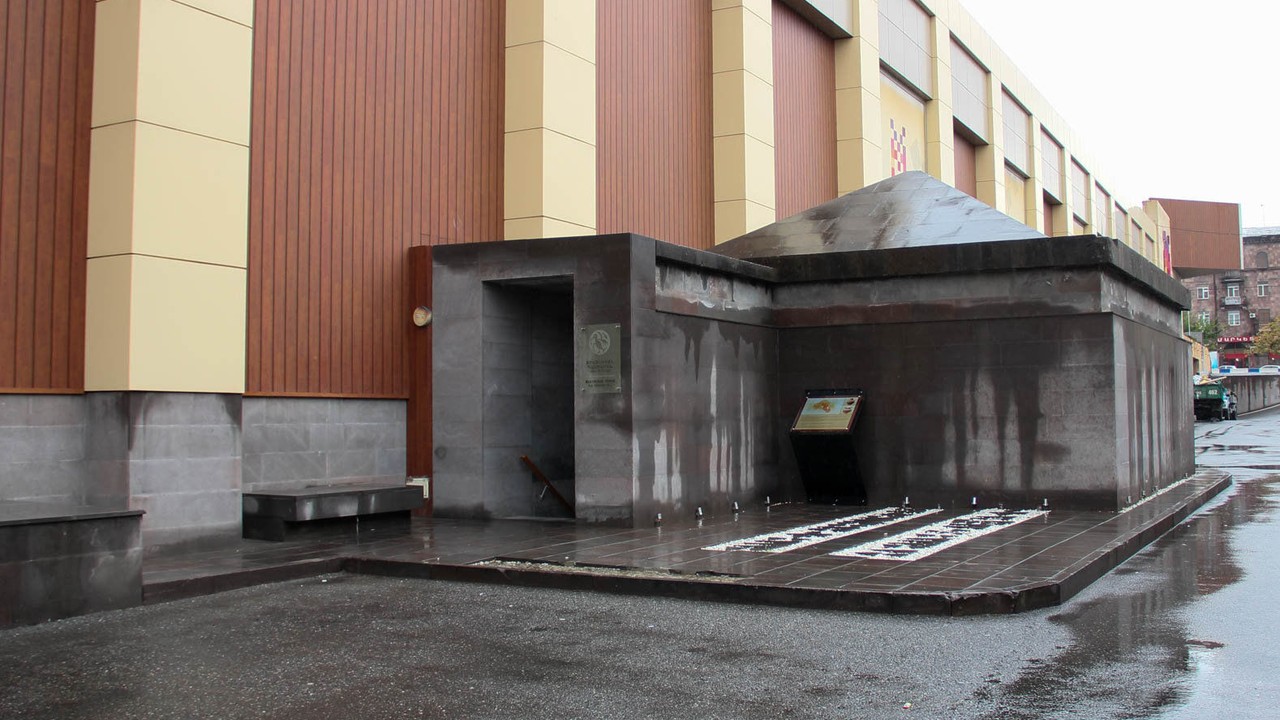
BIAYNIAN TOMB
8th–7th centuries BC
State index: 1.11.8
Located
on Arshakunyats Avenue. It was discovered in 1984 during construction works. It
was studied by the expedition of the Institute of Archaeology and Ethnography
of the Academy of Sciences of the Armenian SSR (archaeologist: Leonid Biyagov;
architect: Armine Kanetsyan). For the preservation of the monument, a
restoration project was prepared in 1984 (author: architect Vladimir
Chagharyan), and conservation works were carried out.
The
monument has survived in a nearly original state. It covers an area of 12 sq.
m. It is an underground rectangular structure oriented north–south. The floor
of the burial chamber is paved with well-worked slabs of black, red, and dark
brown tuff, beneath which secret chambers are located. The walls, preserved to
a height of five courses, are built of finely dressed tuff. The entrance from
the north was sealed with a massive tuff slab (displayed in the tomb). The roof
consists of large tuff beams.
Inside
the burial chamber walls there are niches, from which urns containing cremated
human, animal, and bird bones were discovered, along with a large clay vessel
decorated with bull-headed figurines, a jug, a lamp, bowls, and other items.
Among the finds are bronze snake-headed bracelets, quiver fragments, parts of
horse bridles, nails, an iron sword, knife, daggers, agate beads, a jet seal
with the image of a griffin and a crescent, a bronze ceremonial pin decorated
with a ram’s head relief, three bronze belts, and more.
The
discovered materials are of great historical, cultural, and artistic value. It
is one of the richest known burials of the Kingdom of Van (Urartu). Based on
the finds, it belonged to the Urartian elite.
Near
the Biaynian tomb, an Early Bronze Age stone cist burial was also uncovered.
Pottery dating to the beginning of the 1st millennium BC was found in the
surrounding area.