PLACES OF WORSHIP

KATHOGHIKE HOLY MOTHER OF GOD CHURCH
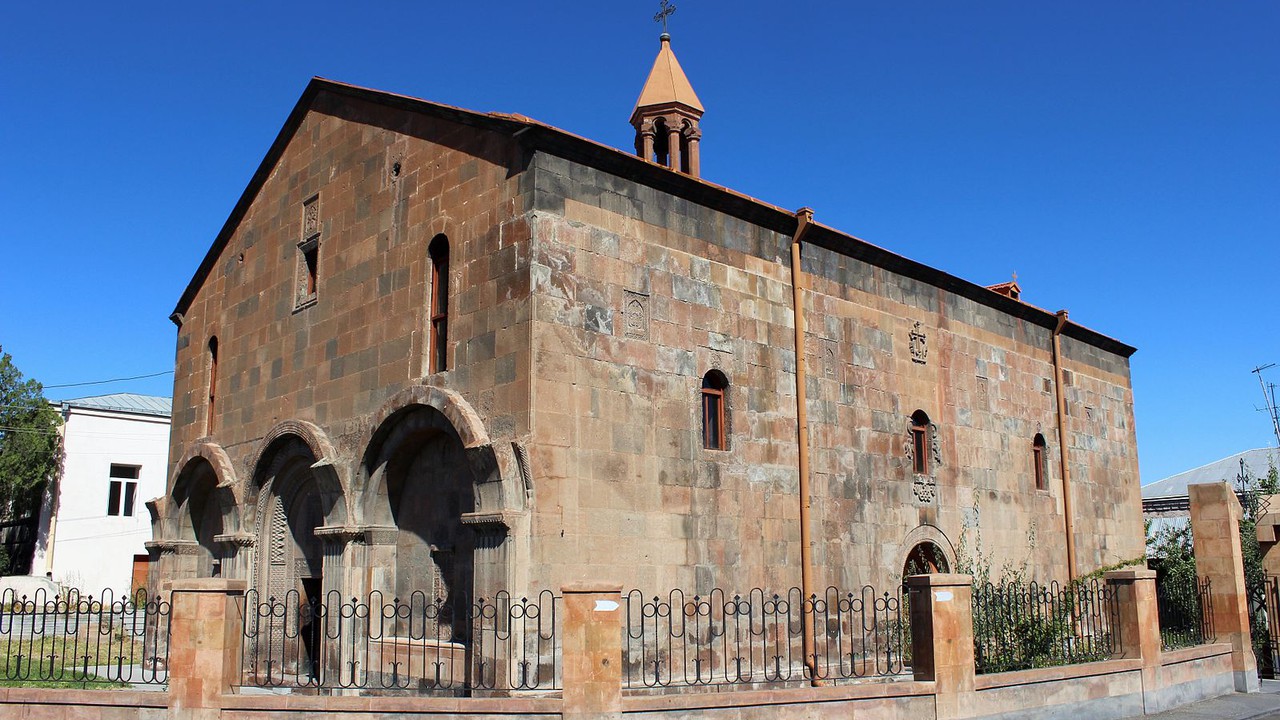
The Katoghike Holy Mother of God Church is a unique surviving monument of medieval Yerevan. 13th c.
State index: 1․6․73
The Katoghike Holy Mother of God Church in
Yerevan is a small (5.4 x 7.6 m), cozy structure. It is dated to the 13th
century, for which the contemporary stone inscriptions preserved on the walls
of the church were taken as a basis, in particular, the earliest text carved on
the southern wall - the 1264 inscription of Sahmadin about the purchase of
Yerevan "with land and water". In 1284, the church received a plot of
land as a donation, in 1301 - two kiosks, in 1318 - lands in Noragavt, in 1598
- a garden. In 1604 during the capture of Yerevan by the Persian Shah Abbas I,
the Holy Mother of God Church was damaged. In 1609, Khoja Grigor built a chapel
next to the church, donated manuscripts, and valuable church utensils. In the
17th century, the Holy Mother of God Church had a residence, where Catholicos
of All Armenians Movses III Tatevatsi lived until the completion of the
renovation of the Mother Cathedral of Echmiadzin. As a result of the 1679
earthquake in the Ararat Valley, the small church remained standing, but the
chapel was destroyed. In 1693-1695, a large three-nave basilica church with two
pairs of cross-shaped nave was built on the site. The western facade of the
small church was transformed into a large arched opening, thanks to which it
was included in the newly built church and served as an altar for the latter.
The Holy Mother of God Church is a domed
structure. As an architectural monument, it was discovered during the
demolition of the large church (December 1936-March 1937), which was carried
out within the framework of the new plan of Yerevan and the project for the
improvement of streets. On the western wall of the church, frescoes depicting
the apostles St. Paul and St. Peter, and the virgins St. Hripsime and St.
Gayane (1819) have been preserved. It is built of smooth tuff.
The Katoghike Church is the only monument
of medieval Yerevan that was built and remained standing until the devastating
earthquake of 1679, therefore it was decided to preserve it. For this purpose,
it was renovated in 1937, and the surroundings were improved. Partial
renovation works were also carried out in 1950. The large arched opening of the
western facade was glazed.
After the construction of the Institute
of Language of the Academy of Sciences of the Armenian SSR, the church remained
in the courtyard of the building for several decades, invisible from the
street. In the 2000s, when the adjacent territory was allocated to the Armenian
Apostolic Holy Church, and construction work on the St. Anna Church began
(2011-2014), the Institute of Language was demolished, and the glass facade of
the church was restored. The 13th-century structure has risen in all its height and is now visible
from all sides. The church is located at 15 Abovyan Street, on the northern
corner of the intersection of Abovyan and Sayat-Nova Streets. It is also called
the “ Yerevan’s place
of prayer.”