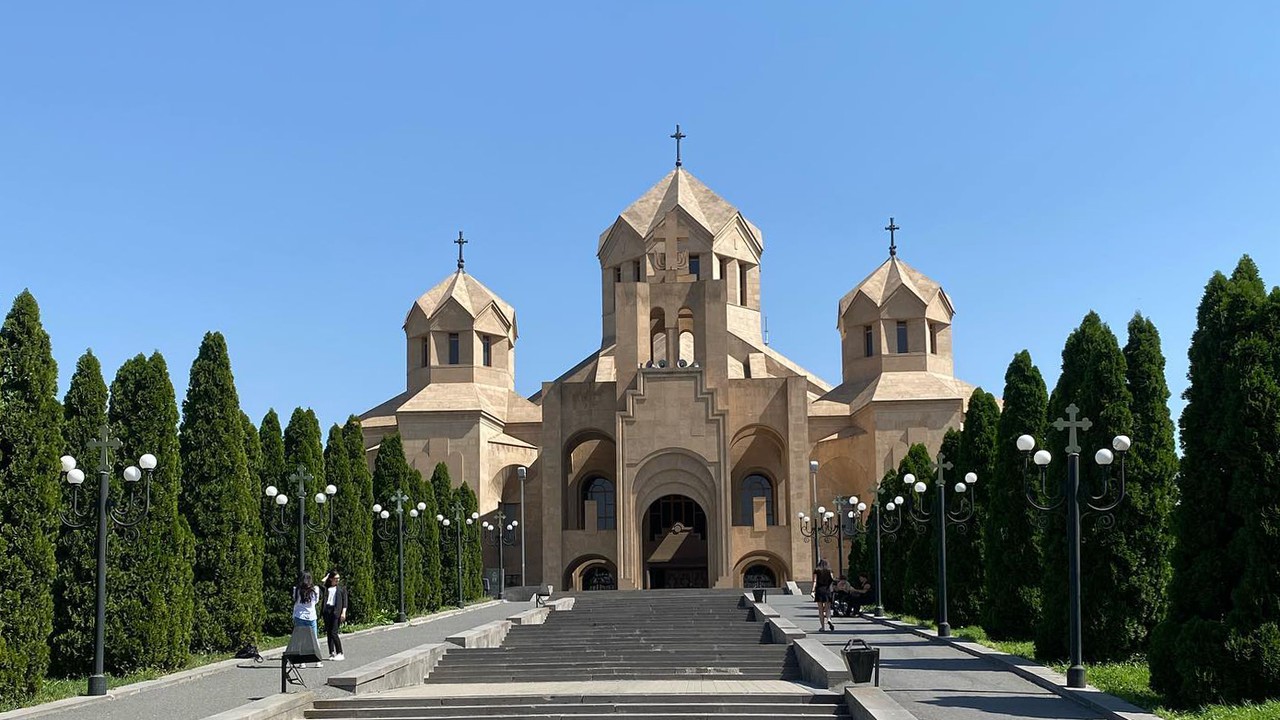
PLACES OF WORSHIP
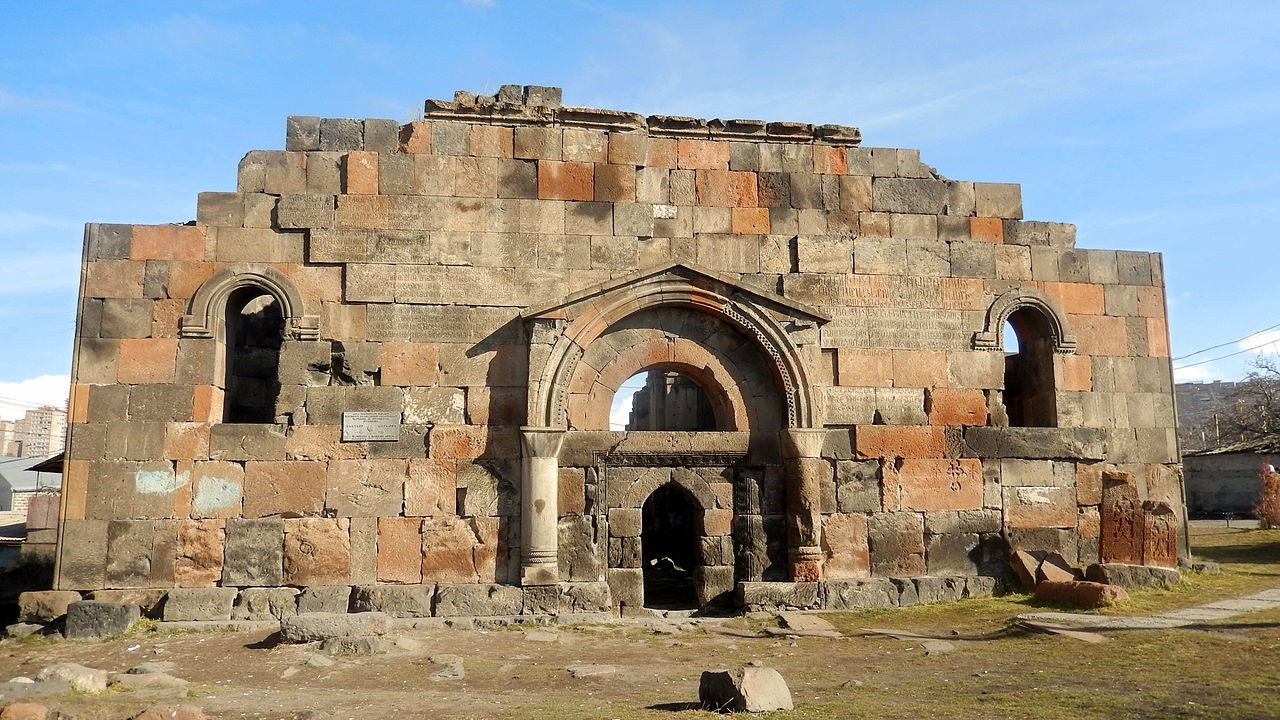
AVAN TEMPLE COMPLEX
The Avan Temple is one of the first five domed churches of Armenian Christian architecture. 6th-7th centuries, 17th century
The Avan Cathedral complex includes
Katoghike Church, the Catholicos Palace, the cemetery with cross
stones, and early medieval
monuments.
The Avan Cathedral or Katoghike Church
(also Tsiranavor, Saint Mother of God) was built by Catholicos Hovhan Bagarants
(591-602) as his residence and the spiritual center of the Byzantine part of
Armenia. It is believed that the architect was Deacon Johann, whose name is
inscribed on the eastern facade of the church. There is a point of view that it
was built on the site of an older building (probably 4th-5th centuries).
It
is a monumental structure made of polished
red tuff, externally
rectangular, internally cross-shaped, domed (the dome has not been preserved),
with four-tabernacle, dome-covered circular sacristies in the four corners. The
floor is tiled. Above the western entrance is a fish-shaped dragon stone
(2nd millennium BC). Inscriptions from the 13th-14th centuries have been
preserved on the walls. This is one of the first five domed churches of
Armenian Christian architecture. This construction served as a prototype for the
Hripsime type monuments in Armenia and Georgia.
The Catholicosate Palace was built in
591-602 by Catholicos Hovhan Bagarantsi on the northern side of the temple. It
is one of the few early medieval secular structures that have survived to us. It
is destroyed.The remains of the walls are 3-4 rows of stones high.
Fragments of early medieval monuments
(6th-7th centuries), 13th-17th century cross-stones (some are inscribed and dated 1191,
1605), and tombstones have been preserved in the cemetery. Catholicos Hovhan
Bagarants, who died in 610-611, is buried on the southern side of the temple.
The monument group was destroyed in 1679
by the devastating earthquake in the Ararat Valley. Excavation and cleaning
works were carried out in 1937, 1940, the late 1950s, and in 1968. It was
partially renovated in 1941 and 1968.