PLACES OF WORSHIP

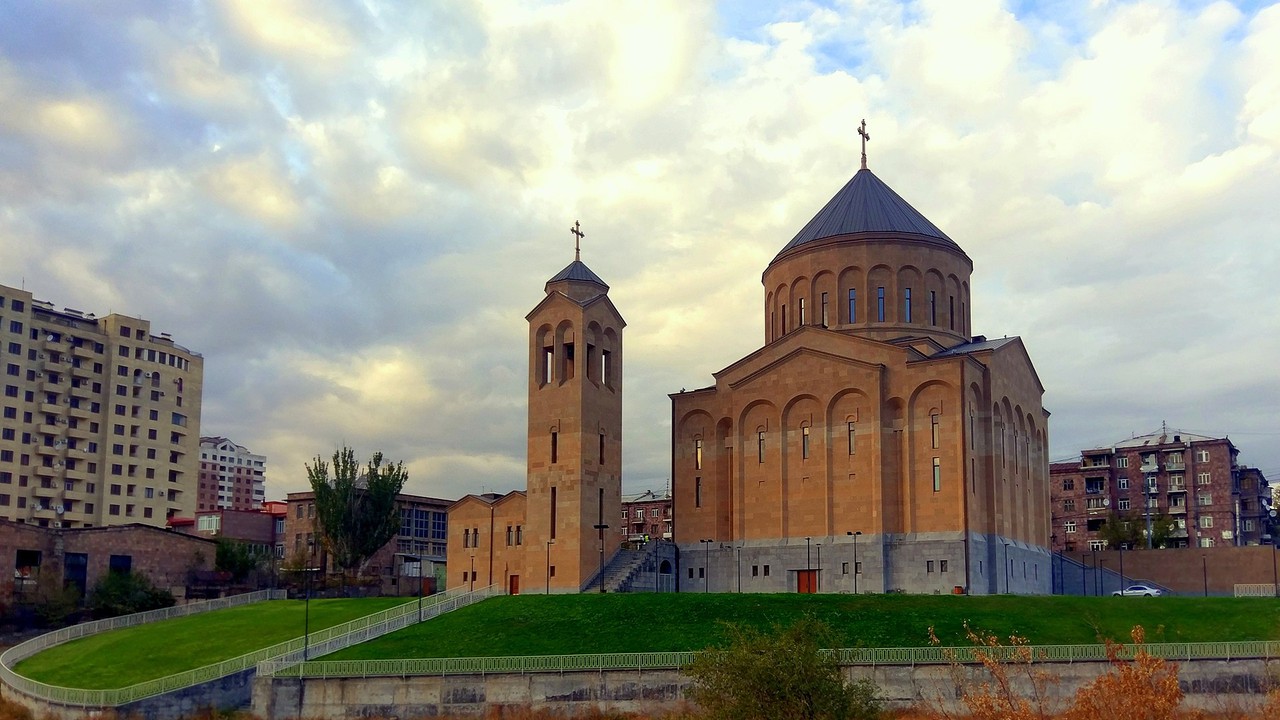
SAINT JHON CHURCH IN AVAN
The Saint Jhon Church houses the Avan renowned walled khachkar (crafted by Grigor Anetsi, 1297), which is one of the best examples of monumental art in medieval Armenia. 5th-6th centuries, renovated: 1271
State index: 1.2.13
The Saint Jhon Church is located in the
Avan administrative district, adjacent to N. Safaryan Street, on a hillside,
south of the Holy Mother of God Church.
No historical information is known about
the construction of the Avan's Saint Jhon Church. The horseshoe shape of the
arch of the altar dome, the isosceles crosses circled on the stone facing the
entrance, and the red-painted frescoes (“Daniel in the Lions’ Den” - 5th-6th
centuries, “Fish” - 5th-6th centuries) testify to the church being founded in
the early Middle Ages. The church is a vaulted (destroyed) single-nave hall,
built on a two-tiered ground floor. The walls are made of reddish and black
polished tuff, decorated with numerous crosses. The cross images surrounding
the altar were carved by the Tserun master, probably in the 10th-11th
centuries. The interior was renovated in 1271 by Avanshah and his son Mevan. It
was destroyed in the devastating earthquake in the Ararat Valley in 1679. In
1968 The church was cleaned, strengthened and partially restored.
The nearby extensive
cemetery (5th-17th centuries) was destroyed as a result of construction.
Fragments of early medieval quadrangular monuments, carved cross-stones,
several dozen flat, rectangular, gable-topped and cradle-shaped tombstones have
been preserved. Some of the cross-stones and tombstones are inscribed
(cross-stone of Norchik, 15th-16th centuries, cross-stone of the 16th century,
composed by Melikset, cross-stone of Marian, 1610, tombstone of Grigores, 1282,
tombstone of Mr. Shnahvor, 1301, etc.).
Here is the renowned walled khachkar of Avan (crafted: Grigor Anetsi,
1297), erected by the couple Luys and Shakarkhatun near the northeastern corner
of the church. It is one of the best examples of monumental art of medieval
Armenia, with its delicate and detailed carvings.