MONUMENTS

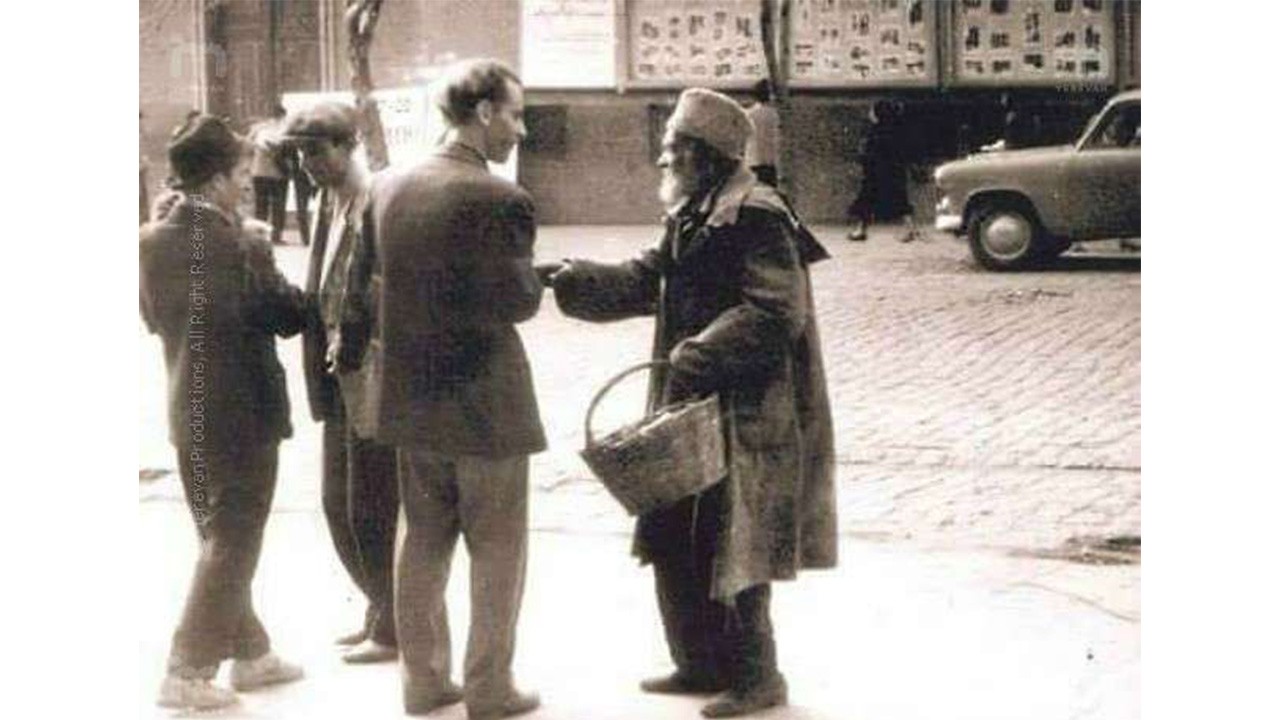
KARABALA – OLD FLOWER SELLER
1995
Beloved
by Yerevan residents, Karabala (trans.: black child), Stepan Harutyunyan, was
born in Kanaker at the beginning of the last century (probably in 1900), into a
wealthy family that owned flower gardens in the area of the current "Yeritasardakan" metro station in Yerevan.
After the establishment of Soviet rule in Armenia, the family was deprived of
property. Stepan married a woman named Ashkhen, had a son. Due to
circumstances, he was arrested and ended up in the same prison cell as Yeghishe
Charents. The woman, without waiting for Stepan's release, sold the house,
married a second time and forbade her son from seeing his father.
Karabala
loved to give flowers to women and girls passing by Astafyan (now Abovyan)
Street, conveying to them the love and kindness he held in his soul. He was
enchanted by the famous actress Arus Voskanyan, who passed by that street on
her way to work at the Sundukyan Theater, and every day he would give her a red
rose.
Deprived
of his home and family, Karabala spent his days near the Central Department
Store, which had become his home, and the neighboring " Caucasus" restaurant,
living in the store's warehouse. Forced to leave the warehouse for several days
due to the store's inspections, he caught a cold outside and died in the
hospital, alone and abandoned. The place of his grave is still unknown.
Poems
dedicated to Karabala were written by Hovhannes Shiraz, Yeghishe Charents, and
Hamo Sahyan. In 1995, his statue was installed at the beginning of Abovyan
Street. Karabala is depicted in old age, with a basket of flowers hanging from
his left arm, and a rose extended forward with his right. The statue is made of
bronze, 2 m high.
The
statue was initially erected on Abovyan Street, near the entrance to the
"Children's World" (formerly Central) department store. Later, due to
the construction of Northern Avenue, it was moved several times (Teryan Street,
Northern Avenue, near the "Moskvichka" store). It is now located a
little further down from its original location, under the wall of the same
department store.