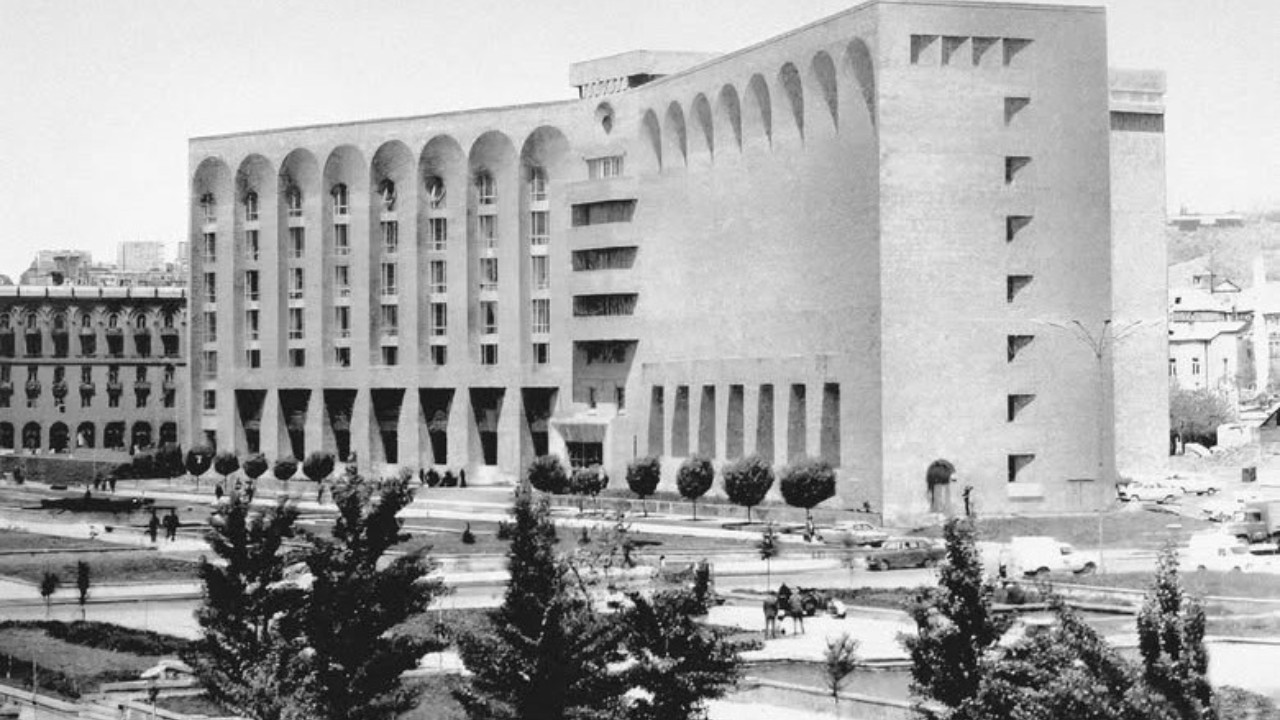
HISTORICAL BUILDINGS
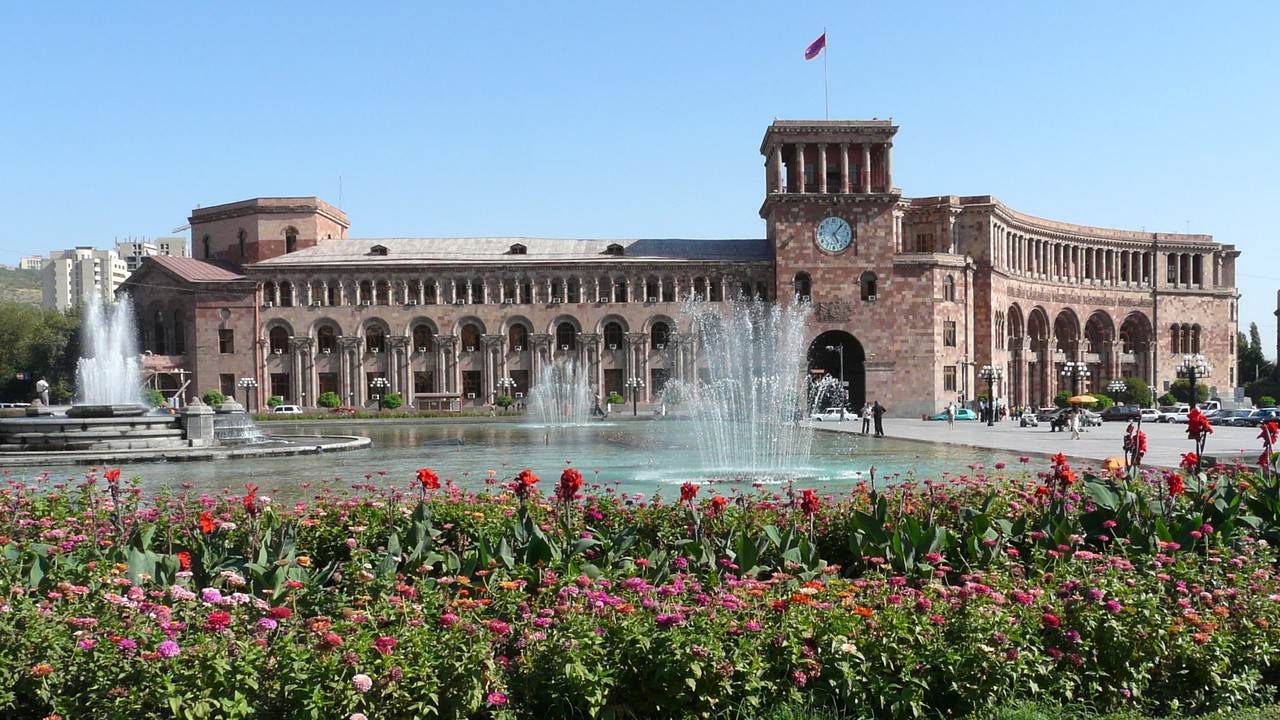
FIRST GOVERNMENT HOUSE
1926-1940, 1950s
The
building is located in the Republic Square complex, bounded by Nalbandyan,
Melik-Adamyan streets and Tigran Mets Avenue.
Architect Alexander Tamanyan designed the
building. His son, architect Gevorg Tamanyan, participated in the design and
continued construction after Tamanyan's death in 1936.
Construction occurred in three phases.
The first phase began in 1926 with the construction of the two-story People's
Commissariat of Agriculture building on Nalbandyan Street, which was later
incorporated into the First Government House. From 1936 to 1938, workers added
a third floor to the Commissariat building.
Construction of the main part of the
Government House began in 1935. Aramayis Yerznkyan, initially as the People's
Commissar of Agriculture and later as Deputy Chairman of the Council of
People's Commissars of the Armenian SSR, directly participated in the
construction of both the Commissariat building and the Government House.
Artist Taragros painted and engraved the
capitals and ornaments of the Commissariat building. Vagharshak Melik-Hakobyan
also created ornamental sculptures. Sculptor Suren Stepanyan created the
bas-reliefs in the triangular lobby at the corner of Nalbandyan and
Melik-Adamyan streets (not all were completed). Architect-artist Basin
participated in the preparation of working drawings.
Gevorg Tamanyan designed the section
facing Melik-Adamyan Street in 1957. Construction took place in 1959 under the
supervision of engineer Levon Yerznkyan. Architects Onik Dokhikyan, A. Harutyunyan, engineers L.
Melik-Haikaryan, G. Janpoladyan, and stonemasons Pato Kharazyan, Mendgiyan
brothers, S. Shahverdyan, and G. Abgaryan participated in the construction of
the main building and the Tigran Mets Avenue wing. Until 1950, the Central
Committee of the Communist Party of Armenia and the City Committee of the CPA
occupied the Nalbandyan Street wing.
The First Government House has an
asymmetrical architectural-planning solution. Corner sections feature
monumental entrances and a 30-meter high tower facing the square, which
includes a clock and an arched passage to the inner courtyard. The tower emphasizes
the transition along Nalbandyan Street to a lower wing (16 m). The
architectural composition uses classical proportions, national architectural
forms, and facade hierarchy, with a corresponding three-step decrease in
decoration from the center. The Government House's architecture introduced
techniques that became the foundation for the formation of Armenian Soviet
architecture and the Tamanyan school. Facades extensively use sculptural
decorations and national ornaments (sculptors: Vagharshak Melik-Hakobyan, Suren
Stepanyan, artist: Taragros). The building's perimeter is 500 m, the central
part's length is 100 m, and its height is 25 m.
In 1939, workers constructed a 12-meter
wide sidewalk in front of the First Government House, which included landscaped
areas.
For the first time in the history of
Soviet Armenian architecture, the entire interior space was faced with stone -
light cream-colored felsite. A mosaic of Vladimir Lenin, leader of the October
Revolution, was placed on the wall.
The First Government House became the
foundation for Republic Square's development and predetermined the
architectural features of subsequently added structures, remaining unsurpassed
in its volumetric and artistic standards.
In 1941, it received the USSR State
Prize.