HISTORICAL BUILDINGS

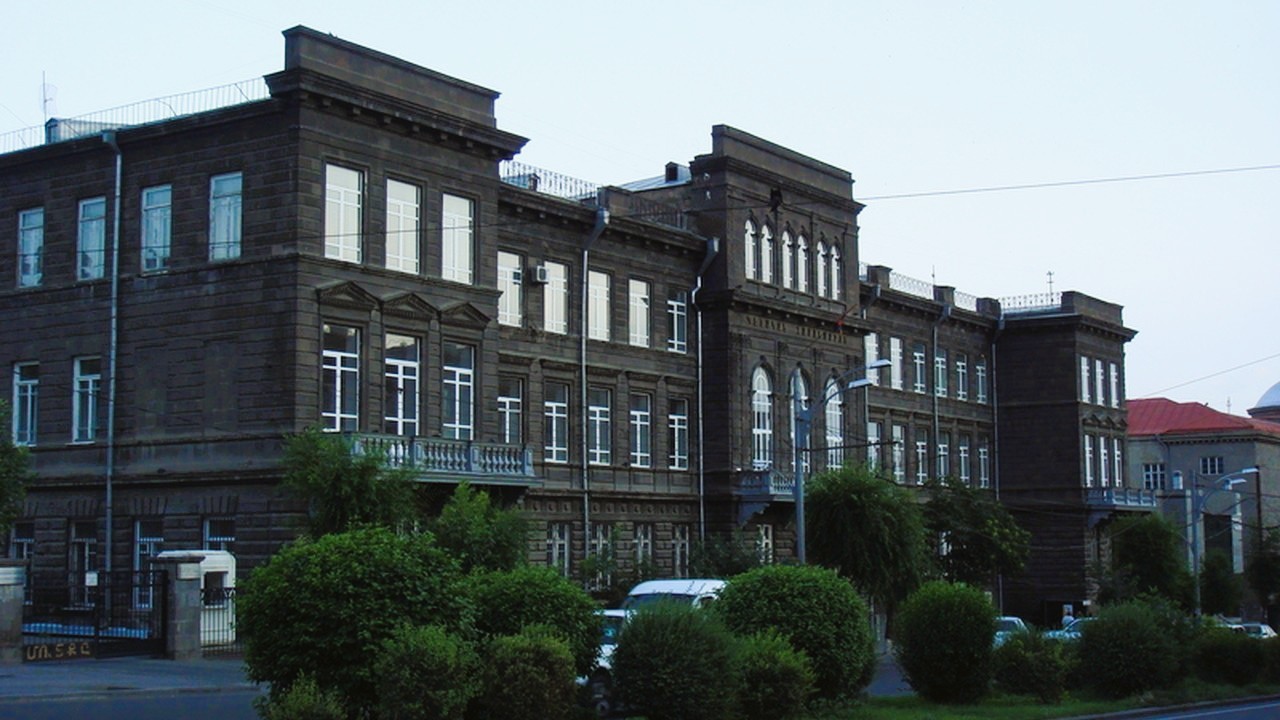
MALE CLASSICAL GYMNASIUM
1896
The
building is located at the intersection of Amiryan Street (formerly Nazaryan,
Nazarovskaya) and Republic Square, next to the second Government House,
opposite the “Armenia Mariott” Hotel.
The
history of the gymnasium dates back to the 1830s. Following the establishment
of the Armenian Province, on January 14, 1832, the first state educational
institution of the region—the Yerevan District School (1832–1868)—was opened.
Khachatur Abovyan served as its inspector from 1843 to 1848. On the basis of
this school, the Yerevan Male Classical Progymnasium (1868–1881) was formed,
and later, on March 3, 1881, the Yerevan Male Classical Gymnasium (1881–1921)
was established. Due to the high tuition fees, the institution was accessible
only to affluent families. By 1885, the educational institution had been fully
organized with one preparatory and eight main classes and produced its first
six graduates.
Initially,
the gymnasium was located opposite the northern corner of Kolubyakin Garden
(now Shahumyan Park), in a complex of one-story buildings belonging to Ye.
Kalantaryan. In 1880, the complex was reconstructed according to the design of
the provincial architect of Yerevan, the German-born Mikhail von der Nonne, in
order to meet educational requirements.
In
1896, the gymnasium moved on a rental basis to Nazaryan Street, into specially
constructed gymnasium buildings designed and supervised by Z. Gevorgyan and M.
von der Nonne. At that time, the gymnasium had a teaching staff of 25 and more
than 250 students. During the following two decades, this number tripled. The
need arose for a new building belonging to the gymnasium, which was constructed
on Astafyan Street between 1911 and 1915 (later known as the House of Culture,
now the Arno Babajanyan Concert Hall and the Museum Building, State Index:
1.6.96.2). The completed sections of the building were used for educational
purposes from 1914 onward.
In
1923, the Nazaryan Street building was nationalized. In 1921, the annex located
inside the courtyard housed incomplete secondary (first-level) Schools No. 1
and No. 5. In December 1920, on the basis of the classical gymnasium, complete
secondary (second-level) School No. 2 was established, which since 1925 has
borne the name of Kh. Abovyan (later relocated to Isahakyan Street). From 1946
to 1976, the annex housed School No. 58, followed by the Yerevan Research and
Design Institute for Automated Urban Management Systems.
In
1921, the street-facing annex housed the Education Department of the Yerevan
District Executive Committee and the Central Pedagogical Museum transferred
from the gymnasium building. In 1922, the Pedagogical Institute was opened
here, but two months later it was moved to the Hripsimyan Gymnasium building
and later merged with Yerevan State University. From August 1935, the building
housed the Av. Isahakyan Central City Library (now relocated to 4/1 Nalbandyan
Street).
The
gymnasium library’s collection of 18,000 volumes was transferred in 1921 to the
State Public Library (now the National Library), while the materials of the
regional studies museum founded during Kh. Abovyan’s tenure at the Yerevan
District School were transferred to the State Museum of Armenia.
In
the 1940s, in connection with the construction of the second Government House,
the right wing of the building was demolished. In 1977, the building was
reconstructed. The walls of the vestibule were clad with red tuff stone, the
floor was covered with marble, and the interior of the hall was renovated.
The
complex originally consisted of two two-story and one single-story buildings
grouped around a small courtyard. The first building, intended for
administrative, dormitory, and partly educational purposes, was situated along
the street’s red line, while its wing enclosed the courtyard from the left
side. The second building was constructed for educational purposes and placed
deeper within the courtyard. The third was a small auxiliary structure
positioned diagonally to enclose the courtyard from the right side. The
orientation of the street dictated the northeast–southwest alignment of the
main buildings, particularly in the case of the second structure. Near it there
was a garden that isolated the classrooms on that side from surrounding noise.