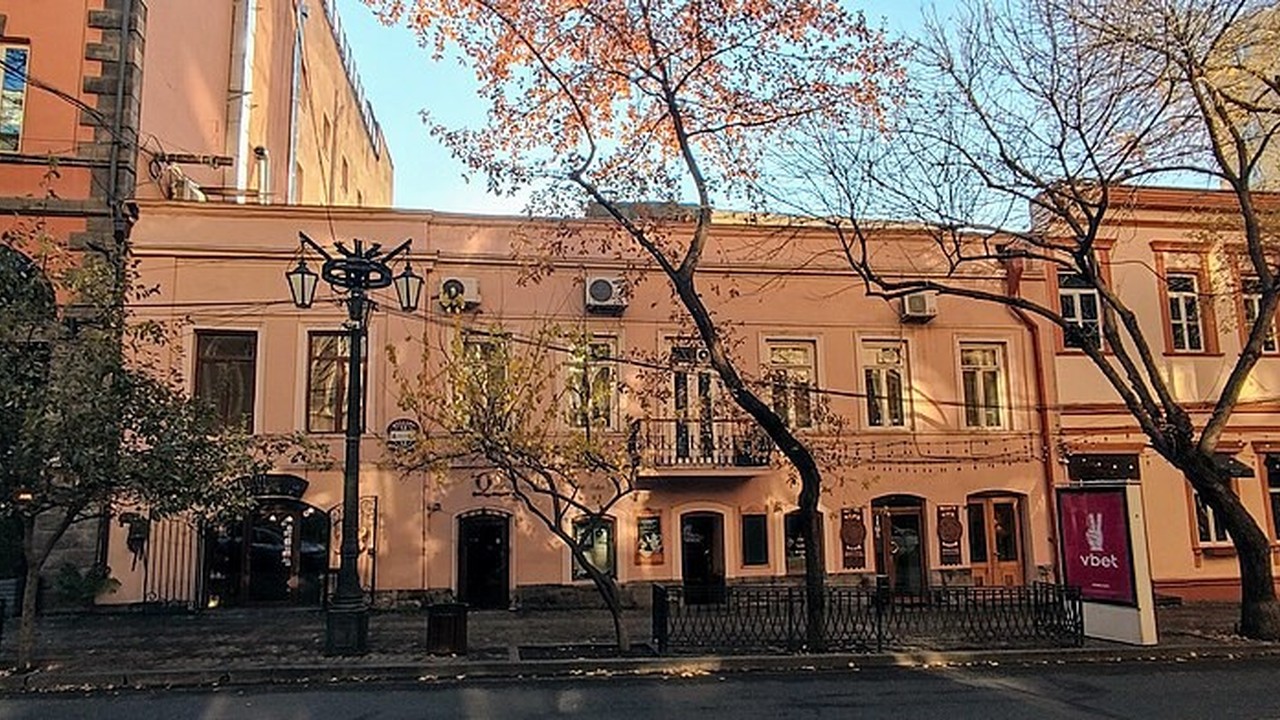
HISTORICAL BUILDINGS

BARSEGH YEGHIAZARYAN RESIDENTIAL HOUSE
1905
The
house is located on Abovyan Street. It is attached to the house of his brother,
Grigor Yeghiazaryan.
Barségh
Yeghiazaryan originally built the house in the first half of the 1880s (1884).
The
house was a two-story structure built of tuff stone. The roof was covered with
sheet metal. It had 7 stoves, 15 doors, and 47 windows. The balcony was made of
wood and iron. The floors were also wooden. It had 12 rooms and 2 kitchens. In
the courtyard there were 3 small shops.
Although
1884 is considered the official construction date, the building was likely
completed later, at the beginning of the 20th century (1905).
The
house belonged to Barsegh Yeghiazaryan, a member of the city duma, a wealthy
merchant, public figure, philanthropist, and one of the sponsors of the Yerevan
water supply system. He also owned the Textile and Cotton Trading Company
founded in 1876, the trading house “B. E. Yeghiazaryan & Co.”, a cotton
pressing factory, and others.
In
1914, the heirs of B. Yeghiazaryan ceded the upper floor of the building to the
charitable “Armenian Hospital.” In 1920, the proclamation of Soviet power in
Armenia was announced from the building’s balcony. Afterwards, until 1937, the
Central Committee of the Communist Party of Armenia was located here. From 1951
to 1981 it served as the City House of Enlightenment named after Stepan
Shahumyan, and since 1981 it has housed the administration of the “Knowledge”
Society of the Armenian SSR.
Restoration works
were carried out between 2015 and 2017. Since 2017, a branch of the “Noyan
Tapan” bookstore has operated for some time in part of the building.
The
Barsegh Yeghiazaryan house is a two-story structure. The main building contains
the group of reception and residential rooms. The narrower side wing contains
auxiliary rooms. The entrance hall and staircase are located in a separate
volume. There are halls facing the courtyard. In the center of the upper floor
is a cantilever balcony connected to the hall.
The
symmetry of the main northwestern façade is broken only by the placement of the
entrance. Vertical articulations divide the façade and emphasize the entrance.
The wall is finished with deep banded rusticated stone. The openings are
semicircular and arched. In the lower row they are framed with rough-hewn
stone, while above they are bordered by flat archivolts. In the vertical
articulations, the windows are triple-sashed with Ionic columns in between.
The
cantilever balcony rests on openwork metal supports and has a similar
balustrade.
The
decorative ornamentation of the building is concentrated on the second floor:
the window niches are decorated with large vegetal reliefs, the lintels feature
various rosettes, the frieze is adorned with simple interlaced ornament, and
the crowning cornice is decorated with dentils and modillions.
The
walls are load-bearing, the ceilings are flat and wooden, and the roof is
pitched. The street-facing façade is clad in black tuff.