SQUARES AND PARKS
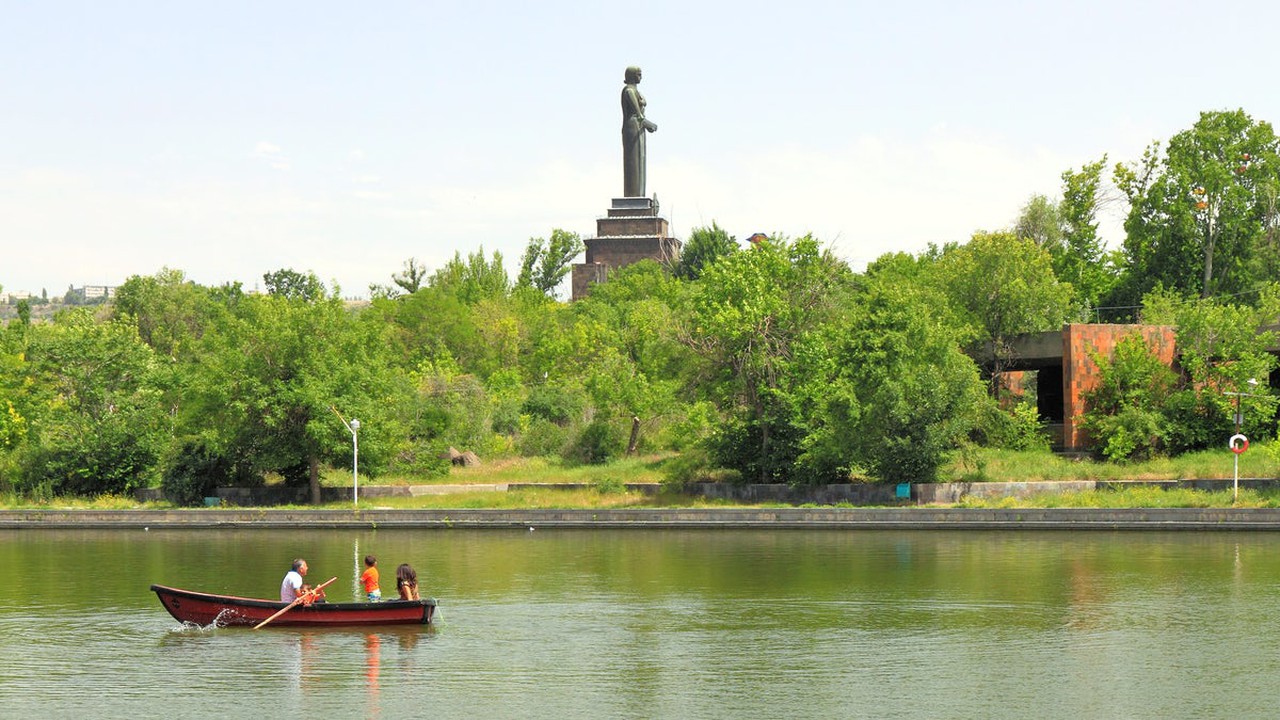
Victory
Park is located on Azatutyun Avenue.
The
construction of the park began in the late 1930s. After the Great Patriotic
War, it was renamed Victory Park, where the Victory Memorial Complex was to be
established.
The
Victory Memorial Complex, featuring a monument to Joseph Stalin, was
inaugurated in 1950. Due to the monument’s monumental scale, Yerevan residents
still refer to the complex, the park, and the surrounding district as
“Monument.”
A
wide central avenue leads from the main entrance to the Victory Monument, from
whose forecourt a panoramic view of the city opens up.
Originally
covering an area of 110 hectares, Victory Park has long been one of Yerevan’s
favorite places for recreation and leisure, especially among young people,
thanks to its various amusement rides, artificial lake, and playgrounds. The
first carousel was installed in the park in 1955–1956.
Lake
“Arevik” was constructed between 1958 and 1961. Its outline replicates that of
Lake Sevan and reaches a depth of up to 8.5 meters. Visitors could both swim in
the lake and take boat rides. Pavilions and other structures were also built
according to the designs of architect Hovhannes Hakobyan. In 1967, the park’s
first Ferris wheel—popularly known as the “Devil’s Wheel” («Чертово
колесо»)—was installed, followed by a second one in 1989.
Within
the park stands the “Aragil” (“Stork”) Restaurant, designed by Rafael Israelyan
and built in 1957 using a combination of white felsite and ochre-colored Ani
tuff. Perched on the heights of Kanaker, it resembles a heraldic stork
overlooking the city. The stork sculpture was created by master stonemason and
jeweler Hrach Stepanyan. Several scenes from the Armenian film Road to the
Circus (1963) were filmed here.
Between
1983 and 1985, reconstruction works were carried out in the park and memorial
complex (architects: Ashot Aleksanyan and Anahit Navasardyan). Heroes’ Alley
was built, and the Tomb of the Unknown Soldier, originally designed by Rafael
Israelyan in 1970, was reconstructed with an eternal flame.
The
park’s main entrance is designed as a triumphal arch and features unique
bas-reliefs. The western retaining wall running along the avenue is built of
brown tuff stone arranged in a diamond-shaped pattern. It was constructed in
1983 according to Rafael Israelyan’s design.
In
2011, additional reconstruction works were carried out in the park.


