HISTORICAL BUILDINGS

MONGOLIAN TOMB
1319 AD
State index:
1.6.68
Architect:
Shahik
The tomb, more precisely its
preserved underground section, is located on Abovyan Street, at a depth of 9
meters in a basement area. It is carved into bright red tuff rock. It was built
in 1319 for a high-ranking official of the Mongol period and his close
associates. The architect was the Armenian master Shahik Vardpet, the builder
of the three-storey Azizbekyants Holy Mother of God Church (1301) in Yeghvard.
An inscription carved on the inner upper part of the underground entrance, in
two languages (Armenian and Persian), records the construction date and the
name of the master builder.
The tomb originally consisted
of both underground and above-ground sections. The underground part was
uncovered during construction works in the late 1990s and was studied in 2001
(archaeologist: Hovik Melkonyan; architect: Artak Ghulyan). Human skeletal
remains, decorative glazed tiles, ornamental bricks, glazed and plain ceramics,
faience, oil lamps, iron parts of the entrance lock, as well as fragments of
the above-ground structure (bases, capitals, decorated arch stones, sculptural
fragments, and remains of muqarnas elements) were discovered.
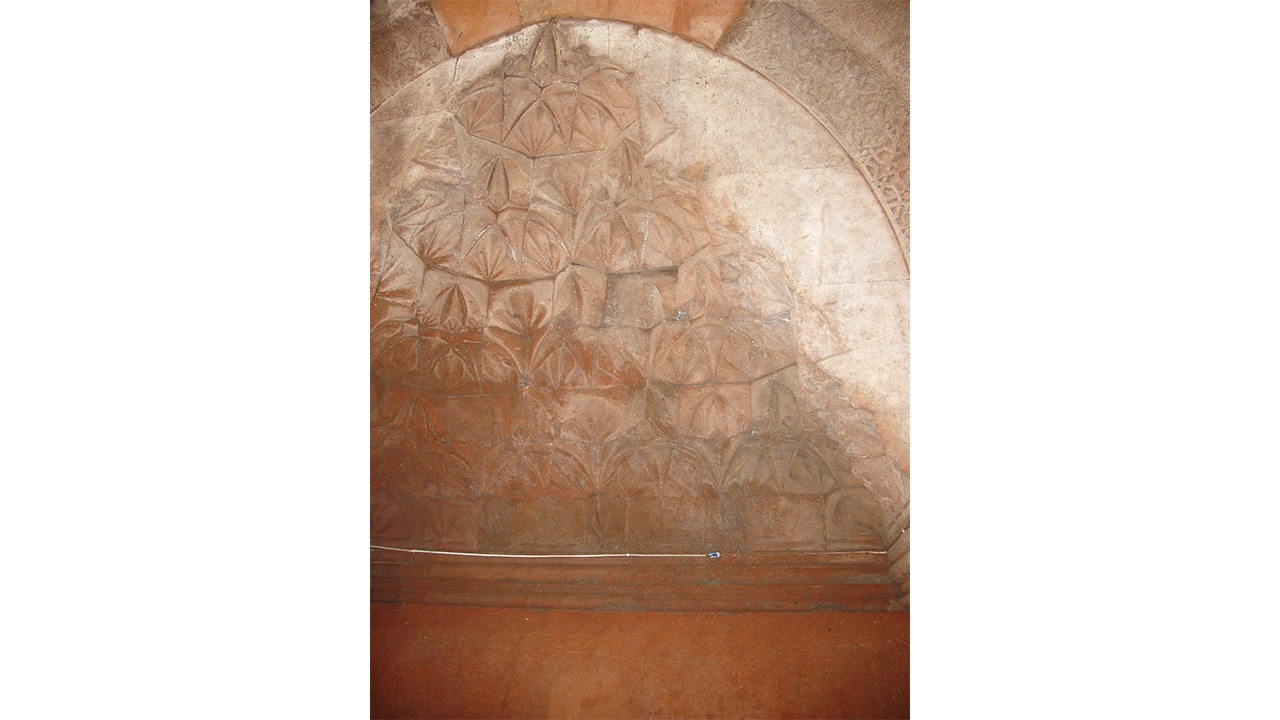
The burial chamber has a
symmetrical cross-shaped plan and is covered with muqarnas vaults supported by
decorated arches with non-repeating ornamental carvings. The interior
decoration includes multicolored glazed tiles. The entrance is from the north
and is connected to the burial chamber by a narrow corridor and stone steps.
The above-ground structure
remained standing until the 1670s. Its description was given in 1673 by the
French traveler Jean Chardin, who referred to it as a tower. It was most likely
destroyed by the great earthquake of 1679, as later travelers to Yerevan make
no mention of it.
The tomb is a valuable monument
of medieval rock-cut architecture and sculpture. It is of significant
importance for the study of Armenian-Mongolian and Armenian-Persian historical
and cultural relations.